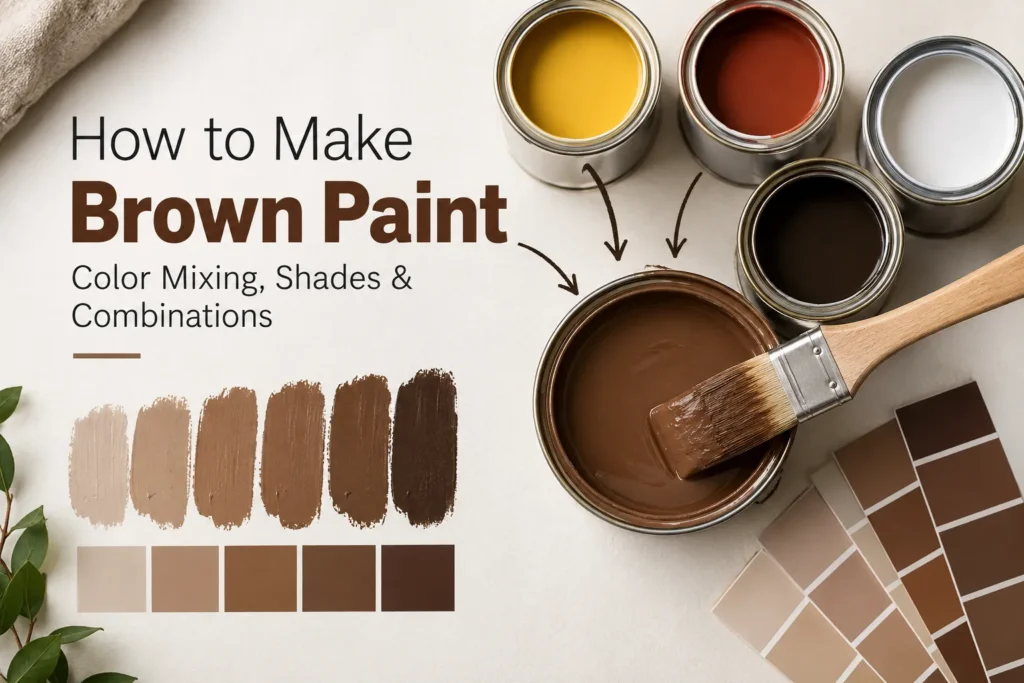
You make brown paint by mixing all three primary colors (red, yellow and blue) or by mixing any two complementary colors, such as red and green, blue and orange, or yellow and purple. The ratio you use and the specific pigments you choose decide whether the brown turns out light, dark, warm, cool or reddish.
That is the short answer. The useful part is knowing why each mix behaves the way it does, so you can steer your brown color on purpose instead of guessing. This guide by Homes Remedy covers the color theory behind brown, starting ratios for every common shade, how to fix muddy brown, and how acrylic paint, oil paint and watercolor change the result.
What Colors Make Brown?
Brown appears whenever a mix contains red, yellow and blue together. You can reach that balance in two ways.
| Method | Colors | What you get |
|---|---|---|
| Three primaries | Red + yellow + blue | A neutral brown you can push in any direction |
| Complementary pair | Red + green | A deep, warm brown |
| Complementary pair | Blue + orange | A rich, balanced brown, the most versatile pair |
| Complementary pair | Yellow + purple | The lightest, most golden brown |
| Shortcut | Orange + black | A quick warm brown, though less lively |
Every method on this list ends up with the same three primaries in the mix. A complementary pair simply delivers them in a different proportion, which is why each pair produces its own shade of brown.
Why Mixing Colors Makes Brown: The Color Theory
Brown is not a separate hue on the color wheel. It is a dark orange with low intensity. When you mix opposite colors, they cancel each other’s brightness, and what remains is a dull, warm, darkened color we call brown.
Three ideas from color theory explain everything else in this guide.
Paint mixing is subtractive
Every pigment absorbs some wavelengths of light and reflects the rest. Red paint reflects red light and absorbs most blue and green. When you add blue paint, it absorbs much of the remaining red and yellow light. With all three primaries in the mix, the paint absorbs most of the spectrum and reflects only a small, uneven amount. Your eye reads that as brown.
Complementary colors neutralize each other
Complementary colors sit directly opposite each other on the color wheel. Each secondary color already contains two primaries, so its complement supplies the missing third one:
- Green (blue + yellow) needs red.
- Orange (red + yellow) needs blue.
- Purple (red + blue) needs yellow.
Think of complements as positive and negative numbers. A small amount of one dulls the other. Equal visual strength cancels most of the color intensity and leaves a neutral brown.
Brown and gray are close cousins
Both come from the same three primaries. The balance decides which one you get:
- More red and yellow (warm side) gives brown.
- More blue (cool side) gives gray or a dull olive.
This is the single most useful rule for mixing brown. If your mix turns gray, it has too much blue. If it turns orange, it needs more blue.
Hue, value and intensity
Every brown has three properties you can adjust separately:
| Property | What it means | How you change it |
|---|---|---|
| Hue (undertone) | Whether the brown leans red, yellow, orange or olive | Add more of one primary |
| Value | How light or dark it is | Add white or yellow to lighten; blue, purple or black to darken |
| Color intensity | How vivid or dull it looks | Add the complement to dull it; add a pure color to brighten it |
When a brown looks wrong, identify which of these three is off before you add anything. That habit prevents most muddy mixes.
How to Make Brown With Red, Yellow and Blue
The primary colors method gives you the most control, because you can adjust each ingredient on its own. Equal parts (1:1:1) produce a dark, neutral brown. In practice, blue is usually the strongest pigment, so most painters get a better result by building the mix in stages.
Step by step
- Mix orange first. Combine about 2 parts yellow with 1 part red. Starting from the warm side keeps the brown from turning gray.
- Add blue in tiny amounts. Add a speck of blue, about a quarter of the red amount, and mix fully with a palette knife.
- Check the color. Too orange? Add a little more blue. Too gray or green? Add red and yellow back in.
- Swatch it. Paint a stroke on scrap paper or canvas and let it dry, because many paints shift as they dry.
- Record the ratio. Write the recipe next to the swatch so you can mix the same brown later.
How the ratio changes the brown
| Ratio (yellow : red : blue) | Result | Why |
|---|---|---|
| 1 : 1 : 1 | Dark neutral brown | Balanced primaries absorb most light |
| 2 : 1 : 1 | Golden brown | Extra yellow lifts value and warms the undertone |
| 1 : 2 : 1 | Reddish brown, close to maroon | Extra red pushes the hue toward red |
| 1 : 1 : 2 | Cool, dark brown that can drift gray | Extra blue cools the mix and lowers intensity |
| 2 : 1 : 0.5 | Bright, orange leaning brown | Less blue leaves more orange showing |
Treat these as starting points. Pigment strength varies between brands and between student and artist grade paint, so one brand’s “1 part blue” can overpower another brand’s red. Always adjust by eye.
How to Make Brown With Complementary Colors
Any two complementary colors make brown, but each pair gives a different brown. The difference comes from value: the darker the two starting colors, the darker the brown.
| Pair | Typical brown | Starting ratio | Best for |
|---|---|---|---|
| Red + green | Deep, warm, slightly reddish | 1 : 1, then add red to warm it | Tree bark, dark wood, shadows |
| Blue + orange | Rich, balanced, easy to adjust | 2 orange : 1 blue | General purpose brown, earth, hair |
| Yellow + purple | Lightest, golden or olive brown | 2 yellow : 1 purple | Sand, wheat, light wood, tan |
Red + green
Red and green produce the darkest brown of the three pairs, because both colors start at a medium to dark value. A warm green (yellow leaning) gives a warmer brown. A cool green such as phthalo green gives a deep, almost black brown, so add it slowly.
Blue + orange
Blue and orange give the most balanced and controllable brown. Orange already holds two warm primaries, so the mix stays on the brown side rather than the gray side. Ultramarine blue with a strong orange gives a classic earthy brown. Add more orange for warmth and more blue for depth.
Yellow + purple
Yellow is the lightest primary, so this pair produces the lightest brown. Too much purple gives the mix a gray or plum tone. Too much yellow makes it olive. Start with yellow and add purple a little at a time until the yellow just loses its brightness.
Why the same pair can give different browns
A tube of green, orange or purple was made from specific pigments. A green mixed from lemon yellow and phthalo blue behaves very differently from a green mixed from cadmium yellow and ultramarine. So two painters using “red and green” can end up with two different browns. Note the exact pigment names on your swatches.
How to Make Different Shades of Brown
Start from a base brown, then shift one property at a time: undertone, value or intensity. The table gives a quick recipe for each shade; the sections below explain the reasoning.
| Shade | Quick recipe | Main lever |
|---|---|---|
| Light brown | Base brown + yellow, then a little white | Value |
| Dark brown | Base brown + ultramarine blue or purple | Value |
| Warm brown | Base brown + red, yellow or orange | Undertone |
| Cool brown | Base brown + a touch of blue | Undertone |
| Golden brown | 2 yellow : 1 red : 1 blue, or base + yellow ochre | Undertone |
| Reddish brown | 1 yellow : 2 red : 1 blue, or base + crimson | Undertone |
| Chocolate brown | Red + green, darkened with ultramarine | Value and undertone |
| Tan | White + small amount of golden brown | Value |
| Beige | Lots of white + a touch of tan, slightly grayed | Value and intensity |
Light brown
Add yellow before white. Yellow raises the value and keeps the brown warm and clean. Then add white in small steps until you reach the lightness you want. Going straight to white often makes light brown look chalky or pink.
Dark brown
Add ultramarine blue, dioxazine purple or a dark green such as phthalo green to your base brown. These colors deepen the value while keeping the brown alive. For the deepest brown, mix a small amount of alizarin crimson with phthalo green and add it slowly. Use black only as a last step (see the next section).
Warm brown
A warm brown leans toward red, orange or yellow. Add any of these to your base brown in small amounts. Red gives a rusty warmth, yellow gives a sunny warmth, and orange gives both. Warm browns suit sunlit wood, autumn leaves and warm skin tones.
Cool brown
A cool brown leans slightly toward blue or gray. Add a very small amount of blue, such as ultramarine or cerulean, to your base brown. Stop as soon as the warmth softens. A little too much turns the mix gray. Cool browns work well for shadows, winter trees and ashy hair.
Golden brown
Use twice as much yellow as red, with blue equal to the red: roughly 2 : 1 : 1. For a richer gold, swap your yellow for yellow ochre, a natural earth pigment that already sits close to golden brown. A touch of orange adds glow.
Reddish brown
Double the red in your primary mix, or add a deep red such as alizarin crimson to a base brown. Use less blue so the mix stays warm. Burnt sienna is already a reddish brown straight from the tube, and it pairs well with any red to make rust, cinnamon or mahogany tones.
Chocolate brown
Chocolate brown is dark, warm and slightly reddish. Mix red and green, which already gives a deep warm brown, then add a little ultramarine blue to deepen it. Alternatively, mix burnt sienna with a touch of ultramarine. Avoid black here, because it flattens the rich red undertone that makes chocolate look like chocolate.
Tan and beige
Tan and beige are very light browns. Build them the opposite way from other browns: start with white and add tiny amounts of golden brown. Mixing white into brown wastes paint, because you need a lot of white to lighten a dark mix.
- Tan: white plus a small amount of golden brown. It stays warm and yellowish.
- Beige: more white, a smaller touch of tan, and a speck of the complement (a little purple or blue) to soften the intensity.
If your beige looks pink, add a speck of yellow. If it looks yellow, add a speck of red and blue.
How White, Black and Other Colors Change Brown
Every color you add to brown moves its hue, value or intensity, and sometimes all three at once. Knowing the side effects helps you pick the right adjuster.
| Add this | Effect on brown | Watch out for |
|---|---|---|
| White | Lighter, softer, more opaque | Chalky look; reddish browns turn pink |
| Yellow | Lighter and warmer, golden | Too much turns it mustard or olive |
| Black | Darker, duller | Flat, dead color; can turn yellow browns green |
| Blue | Darker and cooler | Gray or greenish tint if overdone |
| Red | Warmer, reddish | Turns maroon if overdone |
| Orange | Warmer and brighter | Can look too vivid for natural subjects |
| Purple | Darker, slightly plum | Loses warmth quickly |
| Green | Darker, olive or earthy | Shifts the undertone away from red |
| Gray | Duller, more muted | Loses richness |
White
White raises the value but also lowers the color intensity, which can make brown look pale and chalky. This effect is strongest with reddish browns, which turn pinkish. To keep a light brown warm, add yellow or a little orange alongside the white.
Black
Black darkens brown fast, but it also kills color. Many black paints contain a blue bias, so black mixed into a yellowish brown can drift toward olive green. Use black only when you want a flat, muted shadow, and add it in the smallest possible amounts. For a richer dark, use ultramarine, purple or dark green instead.
Other colors
Any color nudges brown toward itself. Green gives earthy olive browns for foliage and soil. Purple gives plum browns for deep shadows. Gray quiets a brown that looks too bright. Treat each addition as a small correction, not a new ingredient.
Mixing Ratios and How to Fix Muddy Brown
A good mixing ratio is a starting point, not a rule. Three habits matter more than exact numbers:
- Start with the lightest color and add the darker one. It takes far less blue to darken yellow than yellow to lighten blue.
- Add the strong color in tiny amounts. Phthalo blue and phthalo green can overpower a mix with a single brush tip.
- Mix a little more than you need. Matching a brown later is hard, especially across a large area.
What makes brown muddy?
Muddy brown looks dull, dirty and lifeless instead of rich and earthy. It usually means the color intensity has dropped too far or the undertone has drifted. Find the cause, then apply a targeted fix.
| Cause | What you see | Fix |
|---|---|---|
| Too much blue | Grayish or greenish brown | Add red and yellow, or a touch of orange |
| Too many pigments in one mix | Flat, lifeless brown | Start over with just two or three colors |
| Too much white | Chalky, pale, slightly gray | Add yellow ochre or orange to restore warmth |
| Black used to darken | Dead, flat dark brown | Remix and darken with ultramarine or purple |
| Overmixing on the palette | Uniform, dull color | Mix until just combined; leave slight variation |
| Wet paint mixed into wet layers on the canvas | Smeared, gray areas | Let the layer dry, then glaze over it |
| Dull starting colors | Brown without glow | Use brighter paints made from one pigment |
The one color rule
When a brown goes wrong, fix it with one color at a time. Adding more of everything only pushes the mix toward gray. Choose the fix by what you see:
- Too cool or gray: add red or yellow.
- Too orange or bright: add a little blue.
- Too light: add ultramarine or purple.
- Too dark: add yellow before white.
Mixing Brown in Acrylic, Oil and Watercolor
The color theory stays the same in every medium, but each one changes how you lighten brown, how much time you have, and how the color looks once dry.
| Factor | Acrylic paint | Oil paint | Watercolor |
|---|---|---|---|
| How to lighten | Yellow, then white | Yellow, then white | More water; white rarely used |
| Color shift when dry | Dries slightly darker | Very little shift | Dries noticeably lighter |
| Working time | Minutes | Hours to days | Seconds to minutes while wet |
| Best mixing method | Palette knife, mix extra | Palette knife, or glaze on canvas | Mix on palette, or wet into wet on paper |
| Muddy brown risk | Medium | Lower | Highest |
Acrylic paint
Acrylic binder looks milky when wet, so your brown appears lighter on the palette than on the dry canvas. Golden, a major acrylic maker, recommends mixing a step lighter than your target to allow for this. The shift shows most in dark colors such as ultramarine, so dark browns change more than light ones. Some professional lines, such as Winsor and Newton Professional Acrylic, use a binder that dries clear with almost no shift. Either way, swatch every mix and let it dry before you judge it. Acrylic also dries fast, so mix a generous batch, mist it with water, or store it in an airtight container. The upside: you can paint over a wrong brown within minutes.
Oil paint
Oil paint stays workable for hours, which makes it the easiest medium for subtle brown adjustments. You can also build brown optically by glazing thin layers of transparent color over each other. A thin glaze of burnt sienna over a dried blue layer, for example, produces a deep, glowing brown that a single mix rarely matches.
Watercolor
Watercolor uses the white of the paper instead of white paint, so you make light brown by adding water, not white. Colors dry lighter, so mix your brown a little darker than you want. Watercolor turns muddy fastest, because transparent layers show every extra pigment. Keep each brown to two pigments where possible.
Ultramarine blue and burnt sienna make a classic watercolor brown when sienna leads the mix. In roughly equal parts the pair leans toward a neutral gray, and with extra ultramarine it moves toward a cool near black. So use about 2 parts sienna to 1 part ultramarine for brown, and adjust from there. Both pigments can also granulate (the strength varies by brand), which means the pigment settles into the texture of the paper and gives a natural, speckled look that suits rocks, bark and soil.
Pigment Pairs That Make Clean Browns
Generic color names hide big differences between pigments. These real pigment pairs give reliable, clean browns in any medium.
| Pigment pair | Brown it makes |
|---|---|
| Ultramarine blue + burnt sienna | Versatile warm to cool brown, from chocolate to gray brown |
| Ultramarine blue + cadmium orange | Rich, earthy medium brown |
| Alizarin crimson + phthalo green | Very deep, cool brown close to black |
| Cadmium red + sap green | Warm, natural dark brown |
| Yellow ochre + dioxazine purple | Soft, light golden brown |
Tube browns such as burnt umber, raw umber and burnt sienna also make excellent starting points. Adjust them with the same rules in this guide.
Frequently Asked Questions
What two colors make brown?
Any two complementary colors make brown: red and green, blue and orange, or yellow and purple. Orange and black also make a quick brown, though the result looks flatter.
Can you make brown without blue?
Yes, if you have no tube of blue. Mix red and green, or yellow and purple. Green and purple already contain blue, so each pair still supplies all three primaries. Orange plus a little black also works.
Why does my brown look gray?
Your mix has too much blue. Blue lowers warmth and intensity faster than red or yellow. Add small amounts of red and yellow, or a touch of orange, until the warmth returns.
How do you make brown lighter without white?
Add yellow or yellow ochre. Yellow raises the value and keeps the brown warm. In watercolor, add more water instead.
How do you make brown darker without black?
Add ultramarine blue, dioxazine purple or a dark green. These colors deepen brown while keeping its richness, which black tends to flatten.
Why is brown not on the color wheel?
Brown is a dark orange with low intensity, not a pure hue. The color wheel shows pure hues, so brown sits outside it as a mix of those hues.
Conclusion
Brown paint is simply the three primary colors in balance, delivered either directly or through a complementary pair. Control the balance and you control the brown: more red or yellow for warm brown, a touch of blue for cool brown, yellow before white for light brown, and blue or purple instead of black for dark brown. Start small, change one color at a time, swatch every mix, and record the recipes that work.