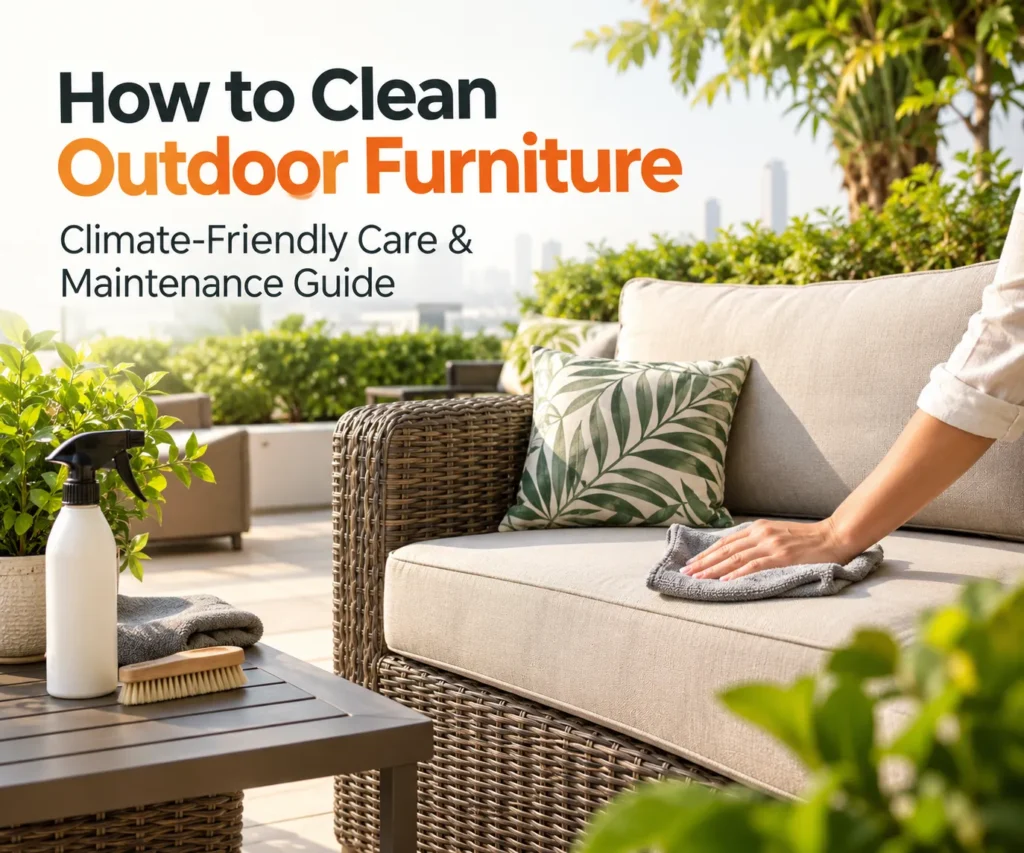
Outdoor furniture works harder than anything else you own. It sits through sun, rain, pollen, bird droppings, spilled drinks, and months of quiet neglect. Most of it still lasts 15 to 20 years if you clean it the right way.
The wrong way costs you twice. Harsh chemicals strip finishes. Pressure washers gouge wood and unravel wicker. Both push you toward replacing furniture years before you need to, and replacement is where nearly all the environmental cost of patio furniture sits.
This guide shows you how to clean every common material, remove the stains that actually show up on patios, protect your set through each season, and do all of it while using less water and fewer chemicals.
How do you clean outdoor furniture?
Clean outdoor furniture in five steps: brush off loose dirt, wash with mild soap and warm water using a soft brush, rinse with a hose or bucket, dry the surface with a microfiber cloth, and let it air-dry fully before you cover it. This method works safely on wood, metal, plastic, resin, and wicker. Skip bleach, abrasive powders, and pressure washers unless the manufacturer specifically calls for them.
Most patio furniture needs a deep clean twice a year and a quick wipe-down every two to four weeks during the season.
What you need to clean patio furniture
You need less than you think. Six items handle 95% of outdoor furniture cleaning.
The core kit:
- Mild dish soap. About 1/4 cup (60 ml) per gallon (3.8 L) of warm water.
- Warm water. Warm lifts grease far better than cold, so you scrub less.
- Soft-bristle brush. A dish brush or car-wash brush works fine.
- Old toothbrush. For wicker weave, screw heads, and joints.
- Two microfiber cloths. One for washing, one for drying.
- Two buckets. One for soapy water, one for rinse water.
Add these for specific jobs:
- White vinegar for mildew on hard surfaces and mineral spots on glass
- Baking soda for odours, light stains, and gentle scrubbing paste
- Cornstarch or plain flour to pull grease and sunscreen out of fabric
- Oxygen bleach powder (sodium percarbonate), a gentler stand-in for chlorine bleach on stubborn mildew
Skip these: stiff wire brushes, scouring powder, steel wool on painted metal, magic-eraser sponges on glossy finishes, and any cleaner labelled “heavy duty” until you have tried mild soap first.
Why mild soap beats specialty cleaners
Specialty patio cleaners cost three to eight times more than dish soap and rarely outperform it on ordinary dirt. Dirt on outdoor furniture is mostly dust, pollen, and organic film. Warm soapy water and a soft brush lift all of it. Save the specialty products for the two or three problems that genuinely need them, such as teak restoration or rust conversion.
The 20-minute basic clean
Do this at the start of the season, at the end, and any time your furniture looks tired.
1. Move cushions and small items out of the way. Shake cushions out and set them somewhere dry.
2. Dry-brush first, always. Sweep off leaves, cobwebs, pollen, and dried mud with a dry brush or cloth. Wet dirt turns to mud and grinds into the surface. This one habit cuts your water use roughly in half.
3. Vacuum the crevices. A shop vac or a household vacuum with a crevice tool pulls trapped pollen and grit from chair joints, weave gaps, and cushion seams. Pollen stains when it gets wet, so remove it dry.
4. Wash with soap and water. Dip your brush or cloth into the soapy bucket. Work in small sections, top to bottom. Use light pressure. Let the soap sit for two or three minutes on stubborn areas instead of scrubbing harder.
5. Rinse. Use your second bucket and a clean cloth, or a hose on a gentle setting. Rinse thoroughly, because leftover soap film attracts dirt and can streak or discolour finishes as it dries.
6. Dry the surface. Wipe metal, glass, and finished wood with a microfiber cloth right away. Standing water causes rust on metal and water rings on wood.
7. Air-dry completely before covering. This step matters more than any other for preventing mould. Give it a few hours in moving air.
How often should you clean outdoor furniture?
Cleaning frequency depends on the material and where you live. Coastal homes, heavy tree cover, and humid climates all push you toward the shorter intervals.
| Material | Quick wipe-down | Deep clean | Protective treatment |
|---|---|---|---|
| Teak and hardwood | Every 2 to 4 weeks | Twice a year | Sealer once a year (optional) |
| Softwood (pine, cedar, acacia) | Every 2 to 4 weeks | Twice a year | Sealer once a year |
| Powder-coated aluminium | Monthly | Every 2 to 3 months | Wax twice a year |
| Wrought iron and steel | Every 2 to 4 weeks | 3 to 4 times a year | Wax twice a year, touch up paint as needed |
| Plastic and resin | Monthly | Twice a year | UV protectant once a year |
| Natural wicker and rattan | Weekly dusting | Twice a year | Sealer every 1 to 2 years |
| Resin wicker | Every 2 to 4 weeks | Twice a year | None needed |
| Cushions and outdoor fabric | Brush weekly | Twice a year | Fabric protector once a year |
Extra rule for coastal homes: rinse everything with fresh water once a month. Salt in the air settles on every surface and eats through protective finishes far faster than ordinary grime. A quick rinse is cheap insurance.
How to clean wood outdoor furniture
Wood needs the gentlest approach of any patio material. It absorbs water, it scratches, and it splinters under pressure.
Basic method for all outdoor wood:
- Brush off loose dirt with a soft brush.
- Mix mild dish soap into warm water.
- Scrub with the grain, never across it. Scrubbing across the grain lifts wood fibres and leaves a fuzzy surface.
- Rinse with a gentle stream of water. Do not soak the wood.
- Wipe with a cloth, then let it dry fully in the shade.
Never pressure wash soft wood. Even a low setting cuts channels into the surface, tears out the softer growth rings, and leaves a striped, raised texture that traps dirt and holds moisture. That damage is permanent.
Teak
Teak contains natural oils that resist rot and insects. That makes it the most forgiving outdoor wood, and the one people most often over-treat.
If you like the silver-grey patina: do nothing special. Wash with mild soap and water twice a year. The grey layer is surface-level colour change, not decay. It does not weaken the wood.
If you want the honey-gold colour back: use a two-part teak cleaner and brightener. The cleaner strips the grey layer, and the brightener neutralises it and restores tone. Let the wood dry completely, usually 48 hours, before you apply anything else.
Sealer versus oil: a teak sealer sits on the surface and holds colour. Teak oil soaks in and needs reapplying three or four times a year. Oil also feeds mildew in humid climates, which is why many teak owners skip it entirely. If you are unsure, use a sealer or nothing at all.
Light sanding with 220-grit paper removes deep grey and small surface stains. Sand with the grain, wipe off the dust, and stop as soon as the fresh colour appears.
Hardwood, eucalyptus, and acacia
These behave like teak but hold less natural oil, so they dry out faster. Clean the same way. Apply an exterior wood sealer once a year to prevent cracking and splitting. Cracks let water inside the wood, and water inside wood is where rot starts.
Softwoods and painted wood
Pine, cedar, and painted pieces need an intact protective coat more than they need cleaning. Check the finish every spring. Where paint has cracked or the sealer has worn thin, water gets in and the damage accelerates fast. Sand the damaged patch smooth, prime it, and repaint or reseal that area only. Spot repair beats refinishing the whole piece. It takes an hour instead of a weekend and uses a fraction of the product.
How to clean metal outdoor furniture
All metal follows the same short rule: wash with mild soap, rinse, and dry immediately. Water left sitting on metal is the beginning of every rust problem you will ever have.
Aluminium
Aluminium does not rust, which is why it dominates modern patio furniture. It does oxidise into a chalky white film, and most aluminium furniture carries a powder-coated finish that scratches easily.
- Wash with mild soap and a cloth or sponge, not a bristle brush. Bristles scratch powder coating.
- Never use abrasive cleaners, scouring pads, or bleach. All three attack the coating.
- Dry and buff with a microfiber cloth.
- Twice a year, apply a thin coat of car wax. Wax fills micro-scratches, blocks UV, and makes next season’s dirt rinse off with plain water, which saves both soap and scrubbing.
Drain the frames before winter. Hollow aluminium legs collect water through the joints. If that water freezes, it expands and splits the frame from the inside. Tip each piece over, pull off the foot caps or glides, and let the water run out.
Wrought iron
Wrought iron is heavy, durable, and prone to rust wherever its paint gets chipped.
- Wash with mild soap and water, then rinse and dry.
- Inspect the whole frame every spring, paying attention to joints, weld points, and the undersides of feet. Rust starts where you cannot see it.
- Touch up paint chips as soon as you spot them. A chip the size of a grain of rice becomes a hole in three or four seasons.
- Apply a clear spray wax twice a year for a protective layer.
Steel and stainless steel
Treat steel like wrought iron. Stainless resists rust but still shows water spots and tea-coloured surface staining near salt water. Wipe stainless with the grain of the brushed finish, and use a soft cloth rather than anything abrasive.
How to remove rust from patio furniture
To remove rust: sand the spot down to bare metal, wipe away the dust, prime with a rust-inhibiting primer, and repaint. Catch rust early and this takes 20 minutes.
Step by step:
- Put on safety glasses and a dust mask. Rust dust irritates lungs and eyes.
- Sand the rusted area with 80 to 120-grit sandpaper or a wire brush until you see clean, bright metal.
- Feather the edges of the surrounding paint so the repair blends in.
- Wipe the area clean and dry.
- Apply rust-inhibiting metal primer. Let it cure per the label.
- Apply two thin coats of exterior metal paint rather than one thick one.
A vinegar soak works on small removable parts such as bolts, brackets, and hardware. Submerge them for a few hours, scrub with a brush, rinse, dry completely, and oil lightly.
Stop and reassess if rust has eaten through the metal. Holes and soft, flaking sections mean the frame has lost structural strength. That is a welding job or a replacement part, not a paint job.
How to clean plastic and resin outdoor furniture
Plastic and resin are the easiest materials to clean and the easiest to ruin with the wrong tool.
Standard clean:
- Rinse or brush off loose dirt.
- Wash with mild soap and warm water using a soft brush or sponge.
- Rinse and air-dry.
Never use abrasive cleaners or scouring pads on plastic. They cut thousands of tiny scratches into the surface. Those scratches hold dirt permanently, and no amount of washing brings the shine back. This is the single most common way people permanently dull plastic furniture.
For yellowed or dull white plastic: make a paste of baking soda and water, spread it on, let it sit 15 minutes, then wipe with a soft cloth and rinse. It lifts surface film. It will not reverse UV yellowing, which is a chemical change inside the plastic itself.
For green algae film: a 1:1 mix of white vinegar and water, left on for 10 minutes, handles it without bleach.
HDPE and poly lumber, the heavy recycled-plastic furniture that looks like painted wood, is the toughest outdoor material available. Soap and water handles it. For deep mildew in the textured grain, use oxygen bleach powder mixed per the label rather than chlorine bleach.
Store plastic furniture in winter if you can. Cold makes plastic brittle. A chair that survives summer fine can crack under normal weight at 20°F (-7°C).
How to clean wicker and rattan furniture
Wicker is a weaving method, not a material. What you are cleaning could be natural rattan, bamboo, paper-wrapped wire, or synthetic resin. The cleaning approach is nearly the same, but the water tolerance is completely different.
The universal wicker method:
- Vacuum with a soft brush attachment. Wicker traps more dirt in its weave than any other patio material.
- Dip a cloth in mild soapy water and wring it out until it is barely damp.
- Wipe section by section, following the direction of the weave.
- Use an old toothbrush in gentle circles for the gaps.
- Wipe with a clean damp cloth to remove soap.
- Dry it in moving air, ideally in sunlight.
Never soak natural wicker and never pressure wash any wicker. Soaking swells the fibres, and when they dry they shrink unevenly. The weave loosens, sags, and eventually unravels. Pressure washing tears strands outright. Both kinds of damage are effectively unrepairable.
Resin wicker tolerates more water than natural wicker. You can rinse it with a hose. Still avoid pressure washing, because the strands are wrapped around a frame and high pressure lifts them at the ends.
If natural wicker starts to look dry or brittle, apply a thin coat of paste wax or a wicker-specific sealer every year or two. This keeps the fibres flexible.
How to clean outdoor cushions and fabric
Cushions hold moisture, so they cause more complaints than every other part of a patio set combined.
Removable covers
Check the care tag first. Many outdoor cushion covers are machine washable.
- Unzip and remove the cover. Shake it out.
- Wash cold on a gentle cycle with mild detergent.
- Skip the dryer. Heat shrinks outdoor fabric, and a cover that shrank half an inch will not go back on.
- Put the cover back on while it is slightly damp. It stretches into place more easily and dries to a smooth fit.
Fixed covers and slings
- Brush off dry dirt first.
- Mix 1/4 cup (60 ml) mild dish soap into a gallon (3.8 L) of warm water.
- Dip your brush into the solution rather than pouring the solution onto the cushion. This keeps the foam inside from soaking through. Wet foam takes days to dry and grows mould from the inside.
- Scrub gently in small circles.
- Rinse thoroughly. Soap residue left in fabric causes streaks and attracts dirt.
- Stand cushions on edge to dry and turn them every few hours so air reaches every side.
Drying cushions properly
Airflow matters more than heat. A cushion drying flat on a chair traps moisture underneath. A cushion standing on its edge in a breeze dries in a few hours. Never store a cushion that is even slightly damp. That is how a set goes from clean to musty in a week.
Preventing cushion problems
- Bring cushions inside or into a deck box overnight and during rain.
- Store them in a ventilated container, not a sealed plastic bin. Sealed bins trap humidity.
- Apply a fabric protector spray once a year after cleaning. It buys you time to blot spills before they set.
- Flip and rotate cushions monthly so they fade evenly.
Stain removal chart for outdoor furniture
Act fast. A fresh spill takes 30 seconds. The same spill after a week in the sun can take an hour or never come out at all.
Blot, do not rub. Rubbing pushes the stain deeper into fabric and spreads it wider on hard surfaces.
| Stain | What to use | How |
|---|---|---|
| Food, ketchup, coffee, juice | Mild dish soap and warm water | Blot, apply solution with a cloth, let sit 5 minutes, rinse |
| Grease, oil, sunscreen, salad dressing | Cornstarch, then soap and water | Cover in cornstarch, wait 20 minutes, scrape off, then wash |
| Tree sap | Rubbing alcohol on a cloth, then soap | Dab until it softens, lift it off, wash the area |
| Bird droppings | Water first, then soap | Soften with plain water for 10 minutes, lift gently, wash. Never scrape dry, since dried droppings are abrasive and scratch finishes |
| Mildew spots | 1:1 white vinegar and water | Spray, wait 15 minutes, scrub with a soft brush, rinse fully |
| Water stains on wood | Baking soda paste | Rub gently with the grain, wipe, dry |
| Rust runs on stone or concrete | Lemon juice or oxalic acid product | Apply, wait 10 minutes, scrub, rinse well |
| Pollen | Vacuum dry, then soap and water | Always vacuum first, because wet pollen stains |
| Red wine | Soap and water, then oxygen bleach if needed | Blot immediately, treat while damp |
| Ink or marker | Rubbing alcohol on a cotton pad | Dab from the outside edge inward |
| Musty odour | Baking soda | Sprinkle on dry fabric, leave 4 hours, vacuum off |
Always spot test. Pick a hidden area such as the underside of a seat or the inside of a cushion flap, apply your solution, wait 10 minutes, and check for colour change before you treat the whole piece.
How to remove mould and mildew from outdoor furniture
To remove mildew: brush off the dry growth first, spray the area with a 1:1 mix of white vinegar and water, wait 15 minutes, scrub gently with a soft brush, rinse thoroughly, and dry the piece in sunlight and moving air.
The order matters. Brushing dry mildew first removes most of the spores as dust. If you wet it first, you smear it into the surface and make it harder to lift.
Full method:
- Wear a dust mask and gloves. Mildew spores irritate the lungs.
- Work outdoors on a dry, breezy day.
- Brush the affected area with a dry brush. Let the dust blow away from you.
- Spray the vinegar solution and let it sit 15 minutes.
- Scrub with a soft brush. Use a toothbrush for weave and seams.
- Rinse completely.
- Dry in direct sun. UV light kills remaining spores, which is the one job sunlight does better than any product.
- Throw away the sponge or cloth you used, or wash it separately in hot water.
For heavy mildew that vinegar cannot shift, use oxygen bleach (sodium percarbonate) mixed per the package instructions. It breaks down into soda ash, water, and oxygen. It is safer for nearby plants, safer for coloured fabric, and safer for you than chlorine bleach.
Critical safety rule
Never mix bleach with vinegar, ammonia, or any acidic cleaner. The combination releases chlorine gas, which causes serious lung injury. If you use chlorine bleach on something, rinse it completely and let it dry before any other product touches that surface.
Why mildew keeps coming back
Mildew is a symptom, not the problem. It returns because moisture keeps getting trapped. Fix the cause:
- A cover with no ventilation gaps holds humidity underneath
- Furniture sitting directly on damp grass, soil, or a shaded deck wicks moisture upward
- Cushions stored damp, or stored in a sealed bin
- A spot with no direct sun and no air movement
- A blocked drainage hole in a chair frame
Raise furniture on feet or glides. Leave gaps at the bottom of covers. Move a chronically mouldy piece to a brighter, breezier spot.
Protecting outdoor furniture from weather
Cleaning removes damage. Protection prevents it. Protection is cheaper, faster, and far better for both your furniture and the environment.
Sun and UV damage
UV light is the most destructive force your furniture faces, and it works invisibly. It breaks the chemical bonds in plastic, fades dye in fabric, and dries out the oils in wood.
What UV does by material:
- Plastic and resin. Colour fades, then the surface chalks, then it turns brittle and cracks.
- Fabric. Dye fades unevenly, then fibres weaken and tear along seams.
- Wood. Surface oils dry out, the wood greys, then it splits along the grain.
- Powder-coated metal. The finish chalks and dulls, exposing metal underneath.
What to do:
- Position furniture in partial shade where you can. An umbrella or pergola cuts UV damage more than any product you can apply.
- Apply UV protectant to plastic and resin once a year.
- Use fabric with solution-dyed fibres if you are replacing cushions. The colour runs all the way through the fibre rather than sitting on the surface, so it fades far more slowly.
- Rotate cushions and reposition chairs monthly so fading stays even. Uneven fading is what makes a set look old, more than the fading itself.
Rain, humidity, and moisture
Moisture rules:
- Wipe standing water off metal and finished wood after rain
- Raise furniture off the ground with glides, risers, or pads
- Check and clear drainage holes in chair frames every season
- Never store anything damp
- Tip chairs and tables forward after heavy rain so water runs off instead of pooling
Using covers correctly
Covers help enormously and cause problems when used wrong.
Do this:
- Choose breathable, water-resistant covers rather than sealed waterproof ones
- Make sure the furniture is completely dry before you cover it
- Leave a gap at the bottom for airflow
- Use covers with vents if you can find them
- Lift covers on dry days and let everything air out
Avoid this:
- Plastic tarps and sheeting. They trap condensation and turn a cover into a greenhouse for mould.
- Covers pulled tight to the ground with no ventilation.
- Leaving a cover on for months without checking underneath.
Special note on teak: a tight cover traps moisture against the wood and encourages mildew, which does more harm than leaving teak exposed. Either leave teak uncovered or use a loose, well-ventilated cover.
Winter storage
Store indoors if you can: cushions and fabric (always), plastic and resin, softwood and painted wood, natural wicker, and umbrella canopies.
Leave outdoors if you must: teak, cast aluminium, wrought iron, HDPE poly lumber, and stone or concrete pieces.
Before you store anything:
- Clean it thoroughly and let it dry completely, over days rather than hours
- Drain water from hollow metal frames
- Tighten every bolt and screw
- Stack pieces with cloth or cardboard between them so finishes do not rub
- Choose a dry, ventilated space rather than a sealed one
If everything stays outside: stack and tie pieces so wind cannot topple them, raise them off the ground, cover them loosely, and brush snow off rather than letting it sit and melt into joints.
Year-round maintenance calendar
Spring, season opening. Deep clean every piece. Inspect for rust, cracks, loose joints, and worn finish. Tighten all hardware. Touch up paint chips. Apply sealer to wood and wax to metal. Wash cushion covers. Check that covers are still intact.
Summer, active season. Wipe surfaces every two to four weeks. Blot spills immediately. Brush cushions weekly. Rotate cushions monthly for even fading. Rinse monthly if you live near the coast. Keep an eye out for early mildew in humid weeks.
Autumn, closing down. Deep clean everything again. Clear fallen leaves promptly, since wet leaves stain wood and hold moisture against surfaces. Repair anything you noticed during summer. Apply the season’s second coat of wax to metal.
Winter, storage. Store what should come indoors. Cover and secure what stays outside. Check stored items once a month for damp or pests. Brush snow off outdoor pieces after storms.
What to avoid when cleaning outdoor furniture
Most patio furniture damage comes from cleaning, not from weather. This table is the shortest path to keeping your set alive.
| Avoid | Why | Do instead |
|---|---|---|
| Chlorine bleach | Strips finishes, weakens fabric fibres, kills nearby plants, harms aquatic life in runoff | Vinegar solution or oxygen bleach |
| Pressure washing | Gouges wood, unravels wicker, strips powder coating, forces water into joints | Hose on low, or bucket and brush |
| Abrasive cleaners and scouring pads | Permanent micro-scratches that hold dirt forever | Soft brush, cloth, or sponge |
| Wire brushes on finished surfaces | Cuts through protective coatings and starts rust | Soft brush, keeping wire brushes for bare rusted metal |
| Excessive scrubbing | Wears through finishes faster than the dirt ever would | Let the cleaner sit longer instead |
| Soaking wicker | Fibres swell, dry unevenly, and the weave loosens | Barely damp cloth |
| Drying wood in direct hot sun | Rapid drying causes splitting and warping | Dry wood in shade with airflow |
| Storing damp cushions | Mould grows inside the foam within days | Dry fully on edge before storage |
| Skipping the spot test | Discolouration you cannot undo | Test a hidden area, wait 10 minutes |
| Ignoring manufacturer instructions | Some finishes need specific care, and voiding the warranty costs you real money | Read the care tag and keep it |
About manufacturer instructions
Keep the care card that came with your furniture, or photograph it and save it in a folder on your phone. Some finishes have genuinely unusual requirements. Certain teak treatments ruin certain teak finishes, and some marine-grade polymers stain from oils that are harmless on other plastics. Manufacturer guidance overrides every general rule in this guide, including mine.
Climate-friendly outdoor furniture care
The environmental footprint of patio furniture is dominated by one thing: how often it gets replaced. Manufacturing and shipping a new aluminium and fabric patio set consumes vastly more resources than a decade of cleaning it. Everything below either reduces what you send down the drain or extends how long the set lasts.
Use dramatically less water
A running garden hose puts out roughly 2 to 4.5 gallons (8 to 17 litres) every minute. Ten minutes of hose time on a patio set is over 20 gallons (80 litres). A two-bucket wash uses about 5 gallons (20 litres) in total.
Practical water savings:
- Use two buckets, one soapy and one for rinsing. This alone cuts water use by 60 to 75%.
- Always dry-brush first. Removing loose dirt without water means you need far less water to finish the job.
- Fit a shut-off nozzle to your hose so water only flows when you squeeze. Most hose water is wasted while you are scrubbing.
- Clean on cool, overcast days. Soap that dries in the sun needs a second rinse.
- Catch and reuse rinse water for the lawn or ornamental plants, but only if you used plain soap and no bleach, solvent, or specialty chemical.
- Clean before things get bad. Light dirt takes one pass. Heavy grime takes three.
Choose gentler products
- Plant-based, biodegradable dish soap cleans outdoor dirt as effectively as any specialty product.
- Castile soap is a good general choice and is far kinder to surrounding soil and plants than conventional detergents.
- White vinegar handles mildew, mineral deposits, and algae without chlorine.
- Baking soda covers gentle abrasion, odour, and light stains.
- Oxygen bleach breaks down into soda ash, water, and oxygen, so it is a real alternative for heavy mildew.
- Skip fragranced and antibacterial cleaners. Neither helps outdoors, and both add chemicals to your runoff for no benefit.
Cut chemical runoff
Everything you rinse off a patio goes somewhere: into soil, into storm drains, or into groundwater. Storm drains usually discharge to waterways without treatment.
- Never let bleach, solvent, or specialty cleaner run onto grass, garden beds, or into a storm drain.
- Move furniture onto gravel or bare ground before using anything stronger than soap, so the ground filters it rather than the drain carrying it away.
- Collect the runoff in a bucket when using strong products, and dispose of it per your local rules.
- Buy concentrated products rather than pre-mixed sprays. You ship less water and throw away fewer bottles.
Reduce cleaning waste
- Use washable microfiber cloths instead of paper towels. One microfiber cloth replaces hundreds of paper towels and lasts years.
- Reuse old toothbrushes for detail work. They are the ideal tool for wicker weave and joints.
- Cut old cotton T-shirts into rags for drying and polishing.
- Refill one spray bottle rather than buying new ones.
- Buy one large container of dish soap instead of several small ones.
- Wash cleaning cloths together in a full load, and skip fabric softener, which coats the fibres and destroys microfiber’s grip.
Extend furniture lifespan
This is where the real environmental win sits.
- Prevention beats restoration. Covering furniture, wiping spills, and drying surfaces take minutes and prevent damage that takes hours to fix.
- Fix small problems immediately. A loose bolt becomes a stressed joint becomes a cracked frame. A paint chip becomes a rust hole. Both take five minutes to prevent and hours to repair.
- Order replacement parts instead of new furniture. Most quality manufacturers sell replacement slings, glides, hardware, cushions, and sometimes individual frame components.
- Reupholster or re-cover rather than replace. New cushion covers cost a fraction of a new set and change the look completely.
- Refinish rather than discard. Sanding and repainting a metal chair costs a few dollars and an afternoon.
- Buy repairable furniture next time. Bolted joints beat welded ones. Replaceable slings beat sewn-in fabric. Solid wood beats veneer over particle board. Ask whether the manufacturer sells parts before you buy.
When furniture is truly finished
Even then, replacement is not the only exit.
- Donate it. Charity shops, community centres, schools, and community gardens take usable outdoor furniture.
- Sell or give it away through local groups. What is tired to you may be someone’s first patio set.
- Repurpose the parts. Metal frames become plant stands and trellises. Wood slats become planter boxes and shelving.
- Recycle by material. Aluminium, steel, and HDPE poly lumber are all genuinely recyclable. Take them apart and recycle the metal separately.
Repair or replace? A simple decision guide
Repair when the problem is cosmetic or structural but contained. Faded colour, surface rust, worn finish, torn cushion covers, loose bolts, one cracked slat, and a broken sling all have straightforward fixes.
Replace when the frame has failed. Rust holes through load-bearing metal, cracked welds, rotted or soft wood, a plastic frame that has gone brittle and chalky, and a badly unravelled wicker frame all mean the piece can no longer hold weight safely.
A useful test: if the repair costs less than half of a comparable replacement and the rest of the piece is sound, repair it. Furniture that has stayed structurally solid for ten years usually has another ten in it.
Safety overrides economics. A chair with a compromised frame is a fall risk. Do not patch it and hope.
When to hire a professional
Most outdoor furniture cleaning is a DIY job. Call in help for these:
- Structural welding on metal frames, because a failed weld under load is dangerous
- Wicker reweaving on a piece worth restoring, since skilled reweavers exist and do beautiful work
- Full teak restoration on a large or valuable set, where a mistake is expensive
- Professional reupholstery for custom or built-in cushions
- Powder coating for metal, since a professional finish outlasts spray paint by years and is worth it on a good frame
- Antique or heirloom pieces of any material. Get advice before you touch them.
- Extensive mould across a set, especially if anyone in the household has asthma or allergies
Ask professionals what they use. Many services default to pressure washing and strong chemicals. A good one will adjust their method to your materials if you ask.
Frequently asked questions
How often should you clean outdoor furniture?
Deep clean twice a year, at the start and end of the season, and wipe surfaces down every two to four weeks while you are using the furniture. Metal near salt water needs a fresh-water rinse monthly.
Can you use bleach on outdoor furniture?
Avoid it. Bleach strips protective finishes, weakens fabric fibres, damages plants where the runoff lands, and harms aquatic life. Use a 1:1 white vinegar and water mix for mildew, or oxygen bleach for heavier growth. If a manufacturer specifically calls for chlorine bleach, follow their dilution exactly and rinse thoroughly.
Can you pressure wash patio furniture?
Do not pressure wash wood, wicker, cushions, or powder-coated metal. Pressure washing gouges wood, unravels woven strands, forces water into joints, and strips protective coatings. A hose on a gentle setting plus a soft brush cleans just as well without the damage. Only pressure wash if your manufacturer specifically permits it, at their stated PSI and distance.
What is the best cleaner for outdoor furniture?
Mild dish soap in warm water, about 1/4 cup per gallon (60 ml per 3.8 L). It cleans wood, metal, plastic, resin, wicker, and fabric safely. Specialty cleaners are only worth it for specific jobs like teak restoration or rust treatment.
How do you get mildew off outdoor cushions?
Brush the dry mildew off first, spray a 1:1 vinegar and water mix, wait 15 minutes, scrub gently with a soft brush, rinse thoroughly, and dry the cushions on their edge in the sun. Sunlight kills remaining spores.
Will vinegar damage outdoor furniture?
Diluted white vinegar is safe on most plastic, resin, painted metal, and outdoor fabric. Avoid it on natural stone, unsealed marble, and waxed finishes, since the acid etches stone and strips wax. Spot test first, and never mix it with bleach.
How do you keep outdoor furniture from fading?
Position furniture in partial shade, apply UV protectant to plastic and resin once a year, use breathable covers when the set is not in use, rotate cushions monthly so fading stays even, and choose solution-dyed fabric when you replace cushions.
Should you cover outdoor furniture in the rain?
Yes, but only if the furniture is dry when you cover it and the cover breathes. Covering wet furniture with a sealed cover traps moisture and grows mould faster than rain ever would. Leave a ventilation gap at the bottom.
How do you remove bird droppings from patio furniture?
Soften them with plain water for about 10 minutes, then lift them off gently and wash the area with mild soap and water. Never scrape them off dry, because dried droppings are abrasive and scratch finishes. They are also acidic, so remove them promptly.
What should you not use on outdoor furniture?
Avoid chlorine bleach, abrasive cleaners, scouring pads, wire brushes on finished surfaces, pressure washers on soft materials, and any cleaner your manufacturer warns against. Also avoid soaking wicker, storing damp cushions, and skipping the spot test.
How do you clean outdoor furniture without chemicals?
Warm water and a soft brush handle most dirt on their own, especially if you dry-brush first and clean regularly. Add mild plant-based soap for greasy areas, white vinegar for mildew, and baking soda for stains and odours. These four cover nearly every outdoor cleaning job.
Can outdoor furniture stay outside all winter?
Teak, cast aluminium, wrought iron, HDPE poly lumber, and stone can stay out. Bring in cushions, fabric, plastic, softwood, and natural wicker. Clean and dry everything first, drain water from hollow metal frames, and cover loosely so air still circulates.
How do you get grease stains out of outdoor cushions?
Cover the stain in cornstarch or plain flour and leave it 20 minutes to absorb the oil. Scrape off the powder, repeat if the stain is heavy, then wash the area with mild soap and water and rinse. This works on sunscreen, cooking oil, and salad dressing.
Is teak oil good for outdoor furniture?
Only in dry climates, and only on teak that already looks dry. Teak oil feeds mildew in humid conditions and needs reapplying three or four times a year. A teak sealer holds colour longer with less work. Doing nothing at all is a perfectly valid choice, since grey teak is just as strong as gold teak.
The short version
Clean gently and often rather than harshly and rarely. Dry-brush before you add water. Use mild soap, a soft brush, two buckets, and a microfiber cloth. Dry everything completely before you cover or store it. Spot test anything new, and check the manufacturer’s card before you reach for a stronger product.
Do that, and your furniture will outlast three sets bought by someone who scrubs hard with bleach twice a decade. That is better for your budget, your weekends, and the world your patio sits in.